If a pension calculator divides your last basic pay by 70, close it. No government in Pakistan uses that formula, and since January 2025 a federal pension is not worked out on the last pay at all. It is worked out on the average basic pay of your last 24 months.
Punjab rewrote its rules in December 2024, and Khyber Pakhtunkhwa follows a third method. The pension calculator KPK, federal and Punjab employees can use below covers retirements from 1 July 2026. The sections after it explain each step, and the 2026-27 notifications are linked at the bottom so you can check them yourself.
Last checked against the official notifications: 3 November 2026.
Pension changes for 2026-27 at a glance
- Federal: a 7% increase from 1 July 2026, worked out on the baseline pension. It also applies to people who retire on or after 1 July 2026.
- Khyber Pakhtunkhwa: a 7% increase from 1 July 2026.
- Punjab: a 3.5% increase of net pension from 1 July 2026, only for people who had already retired. It does not apply to anyone retiring on or after that date.
- New pay scales: BPS-2026 raised basic pay from 1 July 2026, which lifts the pension of new retirees. For federal employees the 24-month average slows that effect until mid-2028.
- Commutation: still up to 35% for federal and KP employees, but capped at 25% in Punjab.
- Sindh and Balochistan: 7% increases for pensioners in 2026-27. Their rules are summarised further down.
Pension Calculator KPK, Federal and Punjab: Work Out Your Pension
Pick your government and your case: retirement at 60, early retirement, invalid pension or death in service. Then put in your dates and basic pay. The calculator shows your qualifying service, gross pension, commutation lump sum, restoration date, monthly pension and the family pension that would follow.
It is built for retirements on or after 1 July 2026, and you can print the result or save it as a PDF for your DDO.
An estimate from the published rules, not an official pension sanction. Your Accounts Office (AGPR, AG or District Accounts Office) works out the final figure from your service book.
How we checked it. We ran the same inputs through the official pension calculator of the Accountant General Khyber Pakhtunkhwa, updated on 11 August 2026. It handles both federal and KP cases. We tested seven cases, including a minimum-pension case, a December retirement, two deaths in service and a KP officer with partial commutation. All seven matched to the rupee.
Punjab and Sindh have no official online calculator, so those parts follow the provinces’ published rules. The Sindh option is a basic estimate, for reasons explained below.
The Pension Formula in Pakistan, Step by Step
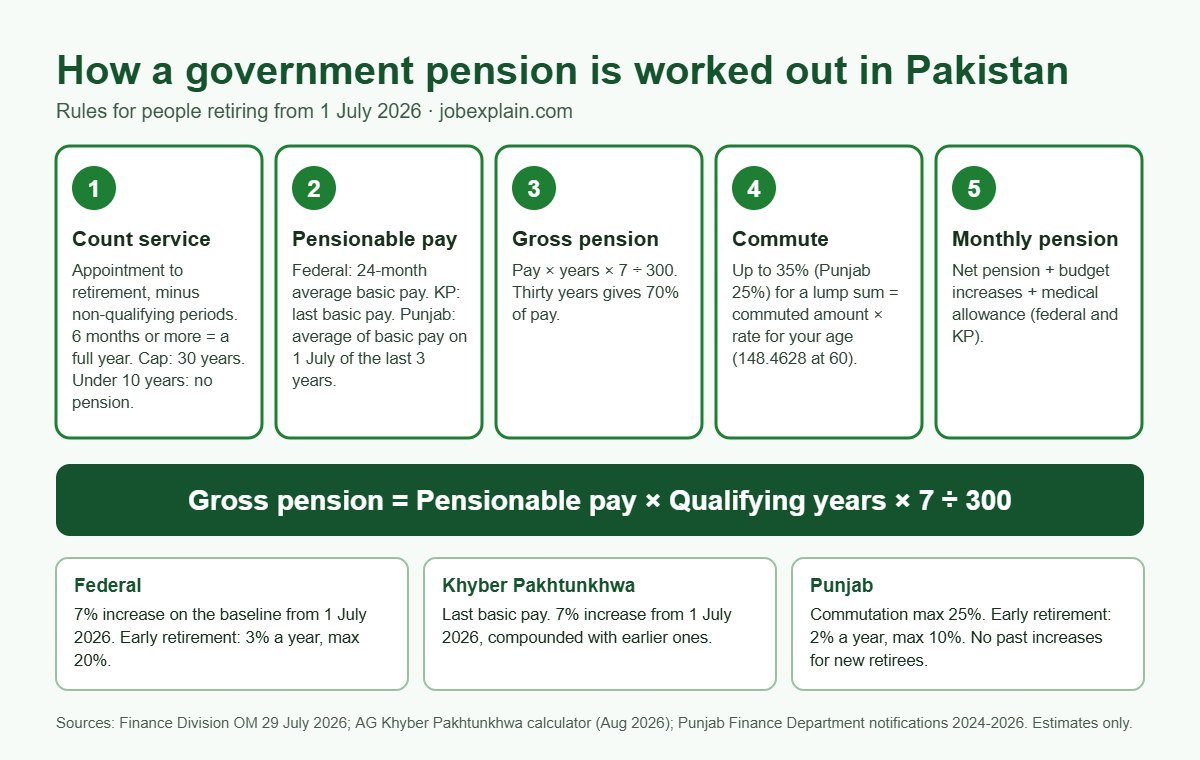
Whether you served in Islamabad, Peshawar or Lahore, the starting point is the same: 7/300 of your pensionable pay for every year of qualifying service, up to 30 years. Thirty years gets you 210/300, or 70% of that pay. Where the governments part ways is which pay goes in, and what gets added afterwards.
Step 1: Count your qualifying service
Qualifying service runs from your date of appointment to your date of retirement. A broken year of six months or more counts as a full year, and five months or less is dropped. Service beyond 30 years adds nothing to the pension.
Some periods do not count at all. Extraordinary leave without pay is the usual example, and your accounts office takes such periods out of your service before rounding. If you had any, enter them in the calculator’s non-qualifying service box.
Under 10 years there is no pension. Service of 5 to 10 years earns a one-time gratuity instead: one month’s emoluments for each completed year. It is one and a half months when service ends through invalidity or death.
Step 2: Work out your pensionable emoluments
- Federal: the average basic pay you drew in your last 24 months of service. Senior Post Allowance is not counted.
- Khyber Pakhtunkhwa: the last basic pay you drew.
- Punjab: the average of the basic pay, including personal pay, that you drew on 1 July of each of your last three financial years.
Federal and KP cases add one more annual increment if you retire between June and November. By then you have completed six months since the 1 December increment date. For federal employees this increment is added after the 24-month average is worked out, for pension purposes only.
Special pay, personal pay or qualification pay can count when your office treats them as pensionable. Punjab’s rules leave out special pay, qualification pay, technical pay, Senior Post Allowance and notional increments, as its Finance Department confirmed in May 2025.
Step 3: Gross pension
Gross pension formula
Gross pension = Pensionable emoluments × Qualifying service (years) × 7 ÷ 300
Example: Rs 100,000 × 30 × 7 ÷ 300 = Rs 70,000 a month.
Step 4: Commutation and net pension
You can give up part of the gross pension for a one-time payment. Federal and KP employees can commute up to 35%, and Punjab employees up to 25%. What is left is your net pension.
The lump sum is the commuted monthly amount multiplied by the commutation rate for your age. For someone retiring at 59 or 60, that rate is 148.4628, which is 12.3719 years of the commuted amount.
Step 5: Increases and medical allowance
Pension increases granted in budgets are then added to the net pension. Federal and KP pensioners also get a medical allowance of 25% of net pension in BPS 1 to 15, or 20% in BPS 16 to 22. A 25% raise is added on top of that allowance.
There is also a floor. A federal pension cannot be lower than Rs 12,000 a month, or Rs 9,000 for a family pension, since 1 July 2023. AG KP’s calculator applies Rs 10,000 and Rs 7,500 for KP pensioners.
This is where federal, KP and Punjab pensioners start to drift apart.
Federal vs KPK vs Punjab: What Is Different
Until 2024 the three systems were close enough that one calculator could serve all of them. That is no longer true. Plenty of pension pages still mix up the Punjab and federal rules, so here is each rule next to the other.
| Rule | Federal and KP | Punjab |
|---|---|---|
| Pay used in the formula | Federal: 24-month average basic pay. KP: last basic pay. | Average of basic pay on 1 July of the last 3 financial years |
| Retiring-year increment | Added if you retire June to November | Not counted |
| Maximum commutation | 35% | 25% |
| 2026-27 increase | Federal 7% of baseline; KP 7% | 3.5% of net pension, only for those retired before 1 July 2026 |
| Older increases for new retirees | Federal: 2011, 2015, 2022, 2023, 2024 and the 7% of 2025. KP: 2022, 2023, 2024 and 2025. | None for retirements after 2 December 2024 |
| Early retirement | Federal: after 25 years, 3% a year up to age 60, maximum 20%. KP: no reduction found. | After 25 years’ service or at 55, whichever is later; 2% a year, maximum 10% |
| Family pension | Federal: spouse, then other family for up to 10 years. Starts at 75% of net pension on AG KP’s method. | Spouse, for life or until remarriage (August 2025 notification) |
| Minimum pension | Federal Rs 12,000 (family Rs 9,000). KP Rs 10,000 (family Rs 7,500) on AG KP’s method. | Not stated in the notifications we read |
| New employees | Federal: contributory scheme if appointed on or after 1 July 2024. KP: contributory scheme for new hires since 2022, as reported. | Contributory scheme for new entrants from 8 January 2024, per the Punjab Finance Department |
Two KP points we could not pin down. We found no early-retirement reduction in the KP rules. The KP family pension rate is also reported differently: AG KP’s calculator uses 75%, while some sources say KP raised it to 100% in 2021. Confirm both with the AG KP office before you rely on them.
Sindh and Balochistan
Sindh notified a reduction for voluntary retirement in August 2025: 10% at age 55, falling by 2% a year to 2% at 59. Voluntary retirement there needs 25 years of service or age 55, whichever comes later. Sindh moved employees appointed from 1 July 2024 to a contributory pension scheme, with 10% from the employee and 12% from the government.
For 2026-27, Sindh notified a 7% pension increase from 1 July 2026. It has also said that people retiring from 1 January 2027 should get their pension on their last day of service. Balochistan raised pensions by 7% in its 2026-27 budget.
We could not confirm from an official Sindh or Balochistan document which pay each province now uses for pension, or how it adds increases for new retirees. So the calculator’s Sindh option asks for the pensionable pay your accounts office uses and shows only the pension on the day you retire.
Worked Examples: One Officer, Three Governments
Take a BPS-17 officer born on 15 September 1966, appointed on 1 March 1992, who retires at 60 on 15 September 2026. Their pension pay figure is Rs 120,000, and they commute the most their government allows: 35% for federal and KP, 25% in Punjab.
| Item | Federal / KP | Punjab |
|---|---|---|
| Qualifying service | 30 years (34 years 6 months served) | 30 years |
| Pay used in the formula | Rs 124,110 (Rs 120,000 plus a Rs 4,110 increment) | Rs 120,000 |
| Gross pension | Rs 86,877 | Rs 84,000 |
| Commuted part | Rs 30,407 (35%) | Rs 21,000 (25%) |
| Lump sum at retirement | Rs 4,514,301 | Rs 3,117,719 |
| Net pension at retirement | Rs 56,470 | Rs 63,000 |
| Increases added | Federal Rs 67,200; KP Rs 43,996 | None |
| Medical allowance | Rs 14,118 | Not included |
| Estimated monthly pension | Federal Rs 137,787; KP Rs 114,584 | Rs 63,000 |
Same officer, same pay, and yet the federal figure is about Rs 74,800 a month higher than the Punjab one. Two rules explain most of it. Federal retirees still have the older pension increases stacked on their baseline, while Punjab employees retiring after December 2024 get none of them.
KP lands in between. KP uses the same pay and commutation as federal in this case, but it adds only the 2022 to 2026 increases, compounded year on year.
Lower grades: a BPS-9 clerk and a BPS-5 employee
Most pensioners are not BPS-17 officers, and lower down the scale the minimum pension starts to matter. Here are two federal employees retiring at 60 on 10 January 2027, both commuting 35%.
| Item | BPS-9, 27 years | BPS-5, 17 years |
|---|---|---|
| Average basic pay (24 months) | Rs 45,000 | Rs 21,000 |
| Gross pension | Rs 28,350 | Rs 8,330 |
| Lump sum at retirement | Rs 1,473,122 | Rs 432,843 |
| Net pension at retirement | Rs 18,428 | Rs 5,415 |
| Minimum pension applied? | No | Yes, raised to Rs 12,000 before the 2024 increase |
| Estimated monthly pension | Rs 46,115 | Rs 17,424 |
The BPS-5 case is why the floor exists. Without it, the increases would be added to a net pension of about Rs 5,400, and the monthly figure would be about Rs 3,900 lower.
Why a 2026 Federal Retiree’s Pension Pay Is Below the Last Pay
The new BPS-2026 scale raised basic pay from 1 July 2026, which sounds like good news for anyone about to retire. The catch is that a federal pension uses the average of the last 24 months. For anyone retiring before mid-2028, most of those months were paid on the old BPS-2022 scale.
Take a BPS-17 officer at the top stage of the scale. They drew Rs 113,470 under BPS-2022 and Rs 136,340 under BPS-2026. If they retire on 30 November 2026, 19 of their last 24 months are on the old scale and 5 on the new one. The average comes to about Rs 118,235, not Rs 136,340.
With 30 years of service, the gross pension is about Rs 82,764 instead of Rs 95,438. That is roughly Rs 12,674 a month less, before commutation and increases, and leaving out the retiring-year increment.
Every extra month on the new scale narrows the gap. It disappears for anyone retiring on or after 30 June 2028, when all 24 months fall under BPS-2026.
The calculator’s “Work it out from my pay changes” link does this for you. Enter each basic pay you drew and for how many months, including the 1 December increment, and it averages them. For your exact stage and increment amount, see our BPS-2026 pay chart and increment table.
How Yearly Pension Increases Are Added
Federal: increases on a fixed baseline
Since January 2025, federal increases are worked out on a baseline pension. On AG KP’s method, the baseline is your net pension plus the older increases up to 2024. Each new increase is a percentage of that baseline and is kept as a separate amount, instead of being compounded on last year’s total. When the commuted part is restored, it is added to the baseline.
For people retiring on or after 1 July 2026, the Finance Division’s memo of 29 July 2026 grants the 7% increase of 2026. It also confirms that the 15% increase of 2022 and the 7% increase of 2025 remain admissible.
The memo does not mention the older increases. AG KP’s official calculator applies the 2011, 2015, 2023 and 2024 increases as well, in line with the Finance Division’s March 2025 clarification. Our calculator does the same.
| Increase | Rate | How it is applied |
|---|---|---|
| 2011 | 15% | On net pension |
| 2015 | 7.5% | On the running total |
| 2022 | 15% | On the running total |
| 2023 | 17.5% | On the running total |
| 2024 | 15% | On the running total, which then becomes the baseline |
| 2025 | 7% | On the baseline |
| 2026 | 7% | On the baseline |
KP: compounded year on year
For a KP employee retiring now, AG KP’s calculator adds five increases on the running total: 15% (2022), 17.5% (2023), 15% (2024), 7% (2025) and 7% (2026). KP’s 2026 increase of 7% took effect on 1 July 2026.
Punjab: no past increases for new retirees
Under Punjab’s December 2024 amendments, increases from earlier years are not applied to people who retire after that date. The 3.5% increase of July 2026 is worked out on net pension, meaning the pension drawn minus medical allowance. The notification says it is not admissible to anyone retiring on or after 1 July 2026.
For future years, Punjab’s rules set each increase at half of the ad-hoc relief allowance given to serving employees, starting from the next financial year. If no relief is granted in a year, pensions do not rise that year.
So a Punjab employee retiring in 2026-27 starts on the net pension shown by the calculator, and the first increase comes with a later budget.
Commutation: Lump Sum or a Higher Monthly Pension?
Commutation is a trade: a smaller monthly pension in exchange for a large payment now. The payment is the commuted monthly amount multiplied by a rate that falls with age. An older retiree is expected to draw pension for fewer years, so the rate is lower.
| Age at retirement | Commutation rate | Equal to |
|---|---|---|
| 55 | 174.7224 | 14.6 years of the commuted amount |
| 56 | 167.8656 | 14.0 years |
| 57 | 161.2080 | 13.4 years |
| 58 | 154.7436 | 12.9 years |
| 59 | 148.4628 | 12.4 years |
| 60 | 148.4628 | 12.4 years |
What the trade costs in rupees
In the federal example above, commuting 35% brings in Rs 4,514,301 once. Without commutation, the same officer’s estimated monthly pension would be about Rs 211,980 instead of Rs 137,787. So commuting costs Rs 74,193 a month, because the increases and medical allowance are also worked out on the smaller net pension.
The lump sum equals only about 61 months of that difference, roughly five years. The lower pension, however, continues until the commuted part is restored, about 12 years (148 months) later. Over that time the reduced pension adds up to about Rs 11 million, against Rs 4.5 million received at the start, before any profit the lump sum might earn.
Punjab’s rules restore it after the number of years the lump sum paid for, which is about 12 years at 60. AG KP’s calculator uses the same period for federal and KP cases. We did not find a separate federal notice on restoration, so confirm the date with your Accounts Office.
None of this means you should turn commutation down. Paying off a high-interest loan, building a house or covering children’s education now can matter more than a higher pension later, and the lump sum can earn profit in the meantime. Run both versions in the calculator before you sign the commutation option. This is general information, not financial advice.
Early Retirement, Family Pension and the Contributory Scheme
Early (voluntary) retirement
Federal employees can retire voluntarily after 25 years of qualifying service. Under the rules notified in September 2024, as reported at the time, the gross pension is cut by 3% for each year left until 60. The cut is reported as capped at 20%. The calculator counts it by completed months, which is how Dawn described the rule.
Punjab allows premature retirement after 25 years of qualifying service or at age 55, whichever comes later. It applies a discount of 2% for each year short of 60, up to 10%. Age is counted in completed years, so someone aged 58 years and 11 months is treated as 58 and loses 4%.
A February 2026 amendment also allows compulsory retirement after 20 years of qualifying service.
An invalid pension, granted when a medical board finds you permanently unfit, uses the same formula on the service you have, with at least 10 years. The calculator handles this as a separate case type.
Family pension
Under the 2024 federal amendments, the family pension first goes to the spouse. If the spouse dies or stops being eligible, other eligible family members can draw it for up to 10 years. Children can draw it only until the age of 21, as reported in the Finance Division’s clarifications. A disabled child keeps it for life.
If an employee dies in service, AG KP’s method splits the gross pension. A quarter is paid to the family as a one-time gratuity, and three quarters as a monthly family pension. The calculator’s death-in-service option works this out for federal and KP cases.
Punjab now gives family pension to the spouse for life or until remarriage, for deaths from 2 December 2024. If there is more than one widow, it is split equally. These limits apply to deaths after the reforms took effect, and family pensions already being paid keep their original terms.
The courts have not always gone along with these limits. In July 2025 the Supreme Court upheld a divorced daughter’s right to her late father’s pension in a Sindh case. Justice Ayesha Malik, who wrote the judgment, said marital status should not decide eligibility at all.
Contributory pension for new employees
None of the formula above applies if you joined after the cut-off dates. Federal civil employees appointed on or after 1 July 2024 are on the Federal Government Defined Contribution scheme. The employee puts 10% of pay into a fund and the government adds 12%.
Punjab moved new entrants to a funded scheme from 8 January 2024, according to its Finance Department, and KP did so for new hires from 2022.
For them, what they get depends on how much the fund has grown by retirement, not on the 7/300 formula.
Armed forces personnel are also outside this page. Their pensions follow the armed forces’ own Pension Regulations, which include a special family pension for the families of shuhada. Use the figures from your service’s pay and pension office.
Everything You Get at Retirement, Not Just the Pension
The pension is not the only money that comes your way when you retire. People tend to forget one or two of these until the last month of service.
| Benefit | What it is | Where it comes from |
|---|---|---|
| Commutation lump sum | Up to 35% of gross pension (25% in Punjab) paid once | Your pension case |
| Leave encashment | Cash for up to 365 days of leave preparatory to retirement, on pay reckonable for pension | Revised Leave Rules 1980, rule 18-A (federal) |
| GP Fund | Your General Provident Fund balance with profit | Your GP Fund account |
| Benevolent fund and group insurance | Grants set by the fund rules for your grade | Your department and the fund |
| Monthly pension | Net pension plus increases and medical allowance | Your pension case |
Under the federal leave rules you choose encashment instead of taking the leave, and you must decide within the window the rules set before retirement. If you do not choose, you are treated as having opted for encashment.
For most pensioners, tax is not a worry. Under the 2025-26 budget proposals, as reported at the time, government pension is exempt up to Rs 10 million a year, and pensioners under 70 pay 5% on the part above that.
Reports differ on whether the commuted lump sum is covered by the same rule, so check the current Finance Act or FBR guidance if your pension is near that level.
Why Pension Cases Get Delayed (and How to Avoid It)
A 2026 study by officers at NIPA Karachi surveyed 25 retired federal employees and 23 officers who had worked in AGPR’s pension wing. The retirees reported waiting 4 to 12 months for their pension to be settled.
Both groups named documentation as the slowest stage: 64% of the pensioners and 73.9% of the officers. The gaps that came up most were missing signatures or seals and no proof of qualifying service. A missing Last Pay Certificate (LPC) and an incomplete service book were also common.
Sixty percent of the pensioners said their case was sent back for corrections very often.
Before you retire: what to sort out first
- Get your service book checked and completed at least a year before retirement, with every posting, promotion and break recorded.
- Ask for your Last Pay Certificate as soon as your last salary is drawn.
- Check that every page of the pension papers carries the required signatures and office seal before it leaves your department.
- Collect no-demand certificates from your department and, if you had government accommodation, from the Estate Office.
- Use the pension papers published by your accounts office. KP’s are on the AG Khyber Pakhtunkhwa pension page, together with the KP Civil Servants Pension Rules 2021.
- If your pension is not settled within a month, ask your office about anticipatory (provisional) pension, which the law allows when a pension has not been determined in that time.
Six Mistakes in Online Pension Calculators
We went through the pages that come up first on Google for this topic, and the same mistakes kept turning up.
- “Pension = last pay × service ÷ 70.” No government uses this. The fraction is 7/300 for each year, which gives 70% of pay only at 30 years.
- “Pension is based on the average of the last 36 months.” Federal pensions use the last 24 months, KP uses the last pay, and Punjab uses three 1 July figures.
- “Federal commutation is limited to 25%.” Federal and KP employees can commute up to 35%. The 25% cap is Punjab’s.
- “The commuted pension comes back after 10 years.” Restoration follows the years the lump sum paid for: about 12 years at 60, and longer for people who retire younger.
- “Punjab still allows 35% commutation.” Punjab reduced the maximum to 25% in its reforms. Federal and KP stay at 35%.
- “The 2026 increase applies to every pensioner.” Punjab’s 3.5% does not apply to anyone retiring on or after 1 July 2026.
What Retirees Are Actually Asking About Their Pension
In September 2026 we went through more than 200 public comments under two widely shared pension videos on Pakistani employees’ Facebook pages, one of them with over 190,000 views. The same doubts kept coming up. Here they are, paraphrased and without names, with the answer worked out from the rules.
“Is the pension restored after 12 years or 15 years?”
This was the biggest argument in the comments, and neither number is right for everyone. The commuted part comes back after the number of years your lump sum paid for, and that depends on your age next birthday when you retired. A couple of commenters said exactly this: go by the restoration table, not the rule of thumb.
| Age at retirement | Commuted part restored after | Restored at roughly age |
|---|---|---|
| 41 | About 24 years | 65 |
| 51 | About 17.7 years | 69 |
| 56 | About 14 years | 70 |
| 60 | About 12.4 years | 72 |
This is where the common belief that “pension doubles at 72” comes from. It only holds if you retired at 60. One commenter retired at 41 in 2016 and asked when his 35% would come back. On the table, the answer is about 24 years later, around 2040.
This table follows the commutation table in use since 2001. If you retired before that, an older table applied and the period can be different, so go by the restoration date written on your PPO.
“I retired early at 56. Is restoration counted from age 60?”
No. It is counted from the age at which you actually retired. At 56 the lump sum is bigger for each rupee you commute (rate 167.87 against 148.46 at 60), and the wait is longer, about 14 years. That puts restoration at around 70.
“Why does the government keep my 35% for 12 years? Do I get profit on it?”
The government is not holding your money. Commutation is a sale: you give up part of the monthly pension and get that part paid up front as a lump sum. Restoration is the point where the lump sum has been paid back, so there is no profit to claim. If you would rather keep the full monthly pension, commutation is optional. Set the slider to 0% in the calculator and compare the two results.
“My father died in service. Will my mother’s family pension get the 35% back?”
In a death-in-service case nothing was commuted. The family gets a gratuity instead, so there is no commuted part to restore. If a pensioner who had commuted dies before restoration, ask the AG or district accounts office how the family pension is worked out, because it depends on the rules in force on the date of death.
“24 years and one day of service: is that counted as 25?”
No. A broken year counts as a full year only when it is six months or more, so 24 years and 7 months becomes 25, while 24 years and one day stays 24. At the other end, one retiree asked why 33 years and 5 months was counted as 30. Service beyond 30 years adds nothing to the pension.
“My papers show fewer years than I actually served.”
Several people said their office had counted 33 years instead of 35, or 22 instead of 32. A wrong service record is much easier to fix before the pension case goes to the AG office than after the pension has started. A year or so before retirement, check your service book against your appointment, promotion and leave orders, and make sure any periods of leave without pay are recorded correctly.
Questions People Ask About Pension Calculation
What is the new pension calculation formula in Pakistan?
Gross pension is still pensionable pay × qualifying years × 7 ÷ 300. The change is in the pay used: since January 2025 federal pensions use the average basic pay of the last 24 months, and since December 2024 Punjab uses the average of basic pay on 1 July of the last three financial years. KP still uses the last basic pay.
How much has pension increased in 2026?
From 1 July 2026, federal pensions rose by 7% of the baseline pension and KP pensions by 7%. Punjab gave 3.5% of net pension, but only to people who had retired before 1 July 2026.
Is this the same as the AGPR pension calculator?
No. AGPR and AG Khyber Pakhtunkhwa run official calculators for the cases they handle. This one uses the same formula, which we matched against AG KP’s results, adds Punjab’s rules and explains each line. The figure sanctioned by your Accounts Office is the one that counts.
What is the minimum service for a pension?
Ten years of qualifying service. Service of 5 to 10 years gets a one-time gratuity instead, and voluntary retirement with pension needs at least 25 years of qualifying service.
Is pension taxable in Pakistan?
For most pensioners, no. Under the 2025-26 budget proposals, as reported, government pension is exempt up to Rs 10 million a year, and pensioners under 70 pay 5% only on the amount above that. Check the current Finance Act if your pension is near that level.
Does the ad-hoc relief allowance count towards pension?
No. Pension is worked out on basic pay and pensionable pays only. The 2026 pay notification states that the Ad-hoc Relief Allowance-2026 is not counted as emoluments for pension or gratuity.
Pension Formula in Urdu: Short Summary
گراس پنشن = پنشن کے قابل تنخواہ × ملازمت کے سال × 7 ÷ 300۔ زیادہ سے زیادہ 30 سال گنے جاتے ہیں، یعنی تنخواہ کا 70 فیصد۔ وفاقی ملازمین کے لیے آخری 24 مہینوں کی اوسط بنیادی تنخواہ، کے پی میں آخری بنیادی تنخواہ اور پنجاب میں آخری تین سال کی یکم جولائی والی تنخواہ کی اوسط لی جاتی ہے۔
آپ گراس پنشن کا 35 فیصد تک (پنجاب میں 25 فیصد) کمیوٹ کر کے یکمشت رقم لے سکتے ہیں۔ باقی ماہانہ نیٹ پنشن ہے، جس پر بجٹ کے اضافے اور میڈیکل الاؤنس لگتے ہیں۔ یکم جولائی 2026 سے وفاق اور کے پی میں 7 فیصد اضافہ ہوا ہے۔
Official Notifications and Sources Used
- Finance Division O.M. No. 4(1)/REG.6/2026, 29 July 2026: Grant of increase in pension to pensioners of the Federal Government
- Finance Division (Regulations Wing), 4 March 2025: clarifications on emoluments for pension and the future increase method
- Punjab Finance Department No. FD.SR-III-4-113/2026, 22 July 2026: Grant of increase in pension to civil pensioners of Punjab
- Punjab Finance Department: Pension Reforms (commutation, early-retirement discount, family pension)
- Accountant General Khyber Pakhtunkhwa: official pension calculator, updated 11 August 2026
- Khyber Pakhtunkhwa Civil Servants Pension Rules 2021
- Batool and others (2026), A Process Efficiency Analysis of the AGPR Pension Settlement Cycle, Journal of Political Stability Archive
- Dawn, 2 January 2025: pension to be calculated on the average of the last two years’ salary
- Dawn, 4 October 2025: Federal Government Defined Contribution pension scheme
- Punjab Finance Department, 30 May 2025: clarification on the December 2024 pension amendments
- Punjab Finance Department, 20 August 2025: family pension to the spouse for life
- Punjab Finance Department, 23 February 2026: voluntary and compulsory retirement amendments
- Punjab Civil Services Pension Rules (Compendium 2008): commutation table and restoration rule
- Finance Division, 5 July 2023: minimum pension Rs 12,000 and family pension Rs 9,000
- Finance Division: Revised Leave Rules 1980, updated 2018 (LPR encashment, rule 18-A)
- 24 News, 23 August 2025: Sindh voluntary retirement reductions
- TechJuice, 31 July 2026: Sindh notifies 7% pension increase
- APP, 17 June 2026: Balochistan raises pensions by 7%
- Business Recorder: budget 2025-26 proposals on tax on pension
Figures checked against these documents in November 2026. Every budget brings new notifications, and a newer notification overrides anything on this page.
This page explains published pension rules for general information. It is not financial or legal advice, and the pension sanctioned by your Accounts Office is final. See our disclaimer.
Before your pension papers go in, run your figures through the pension calculator twice, once with commutation and once without, and take both printouts to your DDO. It makes the conversation a lot shorter.
If you are still in service, work out your exact age on any date to confirm your retirement date and the service you will have completed.













4 thoughts on “Pension Calculator 2026-27: Federal, KPK and Punjab Formula”