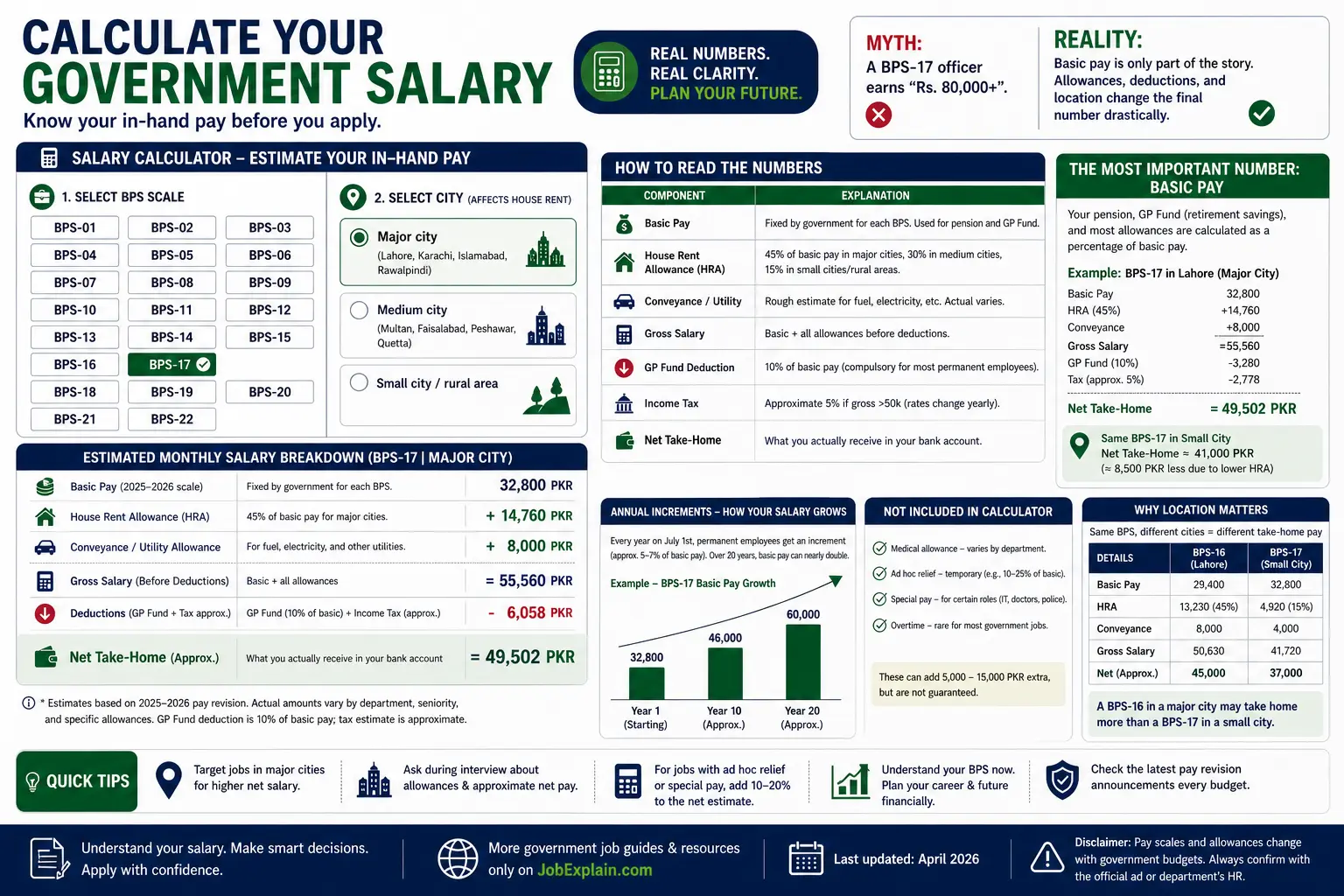
Myth: A BPS‑17 officer earns “Rs. 80,000+”.
Reality: Basic pay is only part of the story. Allowances, deductions, and location change the final number drastically.
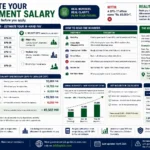
Below is a live salary calculator that shows exactly what a government employee takes home. Select any BPS and a city – you will see estimated basic pay, allowances, deductions, and net salary.
Salary Calculator – Estimate Your In‑Hand Pay
Estimated Monthly Salary Breakdown
| Basic Pay (2025‑2026 scale): | — PKR |
| House Rent Allowance (HRA): | — PKR |
| Conveyance / Utility Allowance: | — PKR |
| Gross Salary: | + — PKR |
| Deductions (GP Fund + Tax approx.): | – — PKR |
| Net Take‑Home (approx.): | — PKR |
* Estimates based on 2025‑2026 pay revision. Actual amounts vary by department, seniority, and specific allowances. GP Fund deduction is 10% of basic pay; tax estimate is approximate.
How to Read the Numbers Above
The calculator uses the 2025‑2026 revised pay scales (minimum of each BPS). Here’s what each component means:
| Component | Explanation |
|---|---|
| Basic Pay | Fixed by government for each BPS. This is the number used for pension and GP Fund calculations. |
| House Rent Allowance (HRA) | 45% of basic pay in major cities, 30% in medium cities, 15% in small cities/rural areas. Some departments give a fixed amount instead – the calculator uses percentages. |
| Conveyance / Utility | Rough estimate for fuel, electricity, etc. Actual varies. |
| Gross Salary | Basic + all allowances before deductions. |
| GP Fund Deduction | 10% of basic pay (compulsory for most permanent employees). |
| Income Tax | Approximate 5% if gross >50k (rates change yearly; this is a simplified estimate). |
| Net Take‑Home | What you actually receive in your bank account. |
The Most Important Number: Basic Pay
Your pension, GP Fund (retirement savings), and most allowances are calculated as a percentage of basic pay. That’s why the basic pay scale matters more than the gross number.
Example:
A BPS‑17 officer in Lahore (basic = 32,800) gets roughly:
- Basic: 32,800
- HRA (45%): 14,760
- Conveyance: 8,000
- Gross: 55,560
- GP Fund (10%): 3,280
- Tax (~5% of gross): 2,778
- Net: 49,502 PKR
A BPS‑17 officer in a small city (basic same, HRA 15% = 4,920, conveyance 4,000) gets net around 41,000. The difference is ~8,500 PKR based purely on location.
Annual Increments – How Your Salary Grows
Every year on July 1st, permanent government employees get an annual increment of approximately 5‑7% of basic pay (fixed amount per BPS, not a percentage). Over 20 years, basic pay can nearly double.
Example (BPS‑17):
Year 1 basic: 32,800
Year 10 basic: approx. 46,000
Year 20 basic: approx. 60,000
The calculator above shows the minimum of the scale (starting salary). If you have been in service for several years, your actual basic pay will be higher.
What Is Not Included in the Calculator
| Item | Why it’s missing |
|---|---|
| Medical allowance | Varies by department (some give fixed 1,000‑2,000, some reimburse actual bills). |
| Ad hoc relief | Temporary increase announced in budgets (e.g., 10‑25% of basic), not permanent. |
| Special pay | For certain roles (e.g., IT, doctors, police). |
| Overtime | Rare for most government jobs. |
These can add 5,000‑15,000 PKR extra, but they are not guaranteed for all posts.
Why You Should Care About BPS Scales Even Before Applying
When a job advertisement says “BPS‑16”, that tells you:
- The minimum basic pay is ~29,400 (from the table above).
- The minimum net salary (small city) is ~37,000, in a major city ~48,000.
- The pension after retirement will be roughly 50‑70% of last basic pay.
- The status and promotion timeline are fixed by BPS grade.
A BPS‑14 clerk may start at 26,100 basic, while a BPS‑17 section officer starts at 32,800 basic – a gap that widens over years.
Common Misconceptions
❌ “I will receive the gross salary shown in the job ad.”
False. Gross includes allowances, but deductions (GP Fund, tax, EOBI) reduce it. The calculator shows net.
❌ “All government employees pay the same tax.”
False. Tax depends on gross income, which varies by city and allowances.
❌ “GP Fund is a waste, I want that money now.”
False. GP Fund is your retirement savings (you get it back + interest when you leave). Also, it reduces your taxable income.
❌ “Higher BPS always means much higher net pay.”
True in general, but a BPS‑16 in a major city may take home more than a BPS‑17 in a small city, due to HRA differences.
Real Example – Two Employees, Different Cities
| BPS‑16, Lahore | BPS‑17, Small City | |
|---|---|---|
| Basic | 29,400 | 32,800 |
| HRA | 13,230 (45%) | 4,920 (15%) |
| Conveyance | 8,000 | 4,000 |
| Gross | 50,630 | 41,720 |
| Net (approx.) | 45,000 | 37,000 |
The BPS‑16 person takes home more because of the city allowance. That’s why location matters when you apply.
How to Use This Information When You Apply
- If you live in a major city, target jobs there – your net salary will be higher.
- If you are willing to move to a small city, competition may be lower, but salary will be less.
- For jobs that offer “ad hoc relief” or “special pay”, add 10‑20% to the calculator’s net estimate.
- Always ask during interview: “What allowances are included and what is the approximate net?” – it’s a normal question.
Next Guide
After you understand pay scales, the next step is preparing for the written test (NTS, PPSC, SPSC, FPSC). That will be Guide 5 in this series.
🔗 Find more government job resources on JobExplain.com
Last updated: April 2026
Disclaimer: Pay scales and allowances change with government budgets. This guide uses 2025‑2026 estimates. Always confirm with the official job advertisement or the department’s HR. The calculator is for illustrative purposes only.