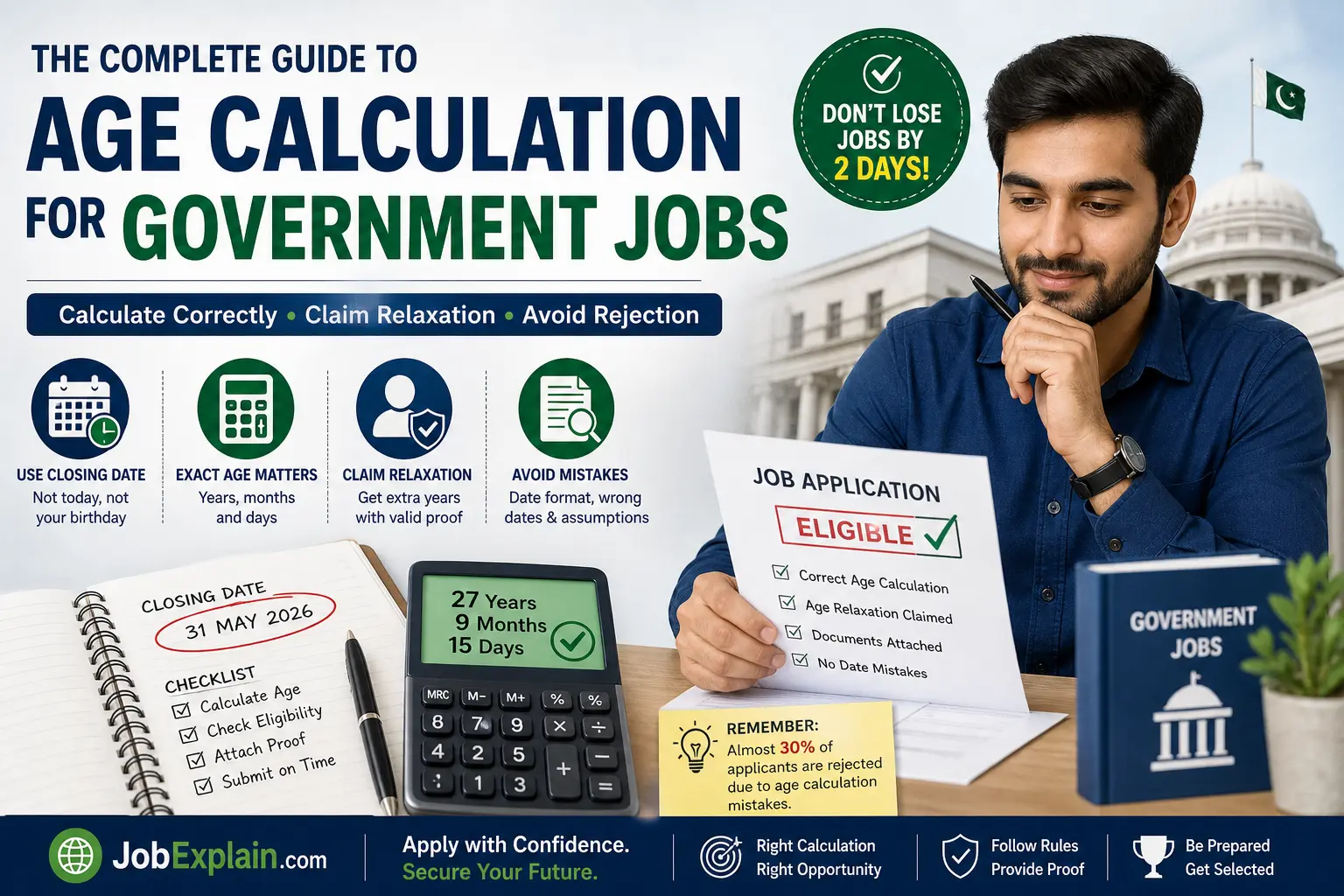
Here is a case that catches applicants every year. An advertisement says “age limit 21 to 25 years”. You are 24 when you read it, so you apply. But your 25th birthday falls two days before the closing date, and age is counted on the closing date, not the day you applied. On that date you are over 25, and the application is rejected as over age. Being out by two days is enough.
That is the mistake this page is meant to stop. Below you will find the method the Punjab Public Service Commission itself publishes for working out age, a calculator that follows it, and the age relaxation rules exactly as the Federal Public Service Commission and the federal relaxation rules state them.
How a commission counts your age
- Your age is taken from your Matric (or O-Level) certificate, not from memory. CNIC or a School Leaving Certificate is used only when the O-Level or equivalent certificate shows no date of birth.
- It is worked out on the closing date of the advertisement. For PPSC competitive exams such as PMS, it is worked out on 1 January of the exam year instead.
- PPSC says a candidate who is under age or over age by even one day is not eligible.
- Relaxation is not automatic. It depends on your category, it must be claimed, and you get only one category plus any general relaxation.
Step 1: Find the Two Dates That Decide Your Age
Your date of birth is the one printed on your Secondary School Certificate (Matric). Both PPSC and FPSC say so. If you passed O-Level or another equivalent exam and the certificate does not show a date of birth, PPSC accepts a School Leaving Certificate, your CNIC or a birth certificate issued by the local council, and FPSC accepts a School Leaving Certificate together with a birth certificate from a hospital or municipal committee.
The closing date is the last date for applications printed in the advertisement. It is not the date the advertisement appeared and not the day you happen to apply. FPSC’s general instructions call it “the cutoff date for calculation of age”. The one exception to watch for is a competitive examination: PPSC reckons age for those on 1 January of the year the exam is held, and the advertisement will say so.
Government Job Age Calculator (PPSC Method)
Enter your date of birth from your Matric certificate and the closing date from the advertisement. Add the upper age limit and any relaxation you are entitled to if you want an eligibility check. The calculator counts age the way PPSC’s published example does, including the one extra day explained in Step 2.
The result is a guide. The advertisement and the commission’s decision are final, and if your birthday falls within a day or two of the closing date, confirm with the commission before you pay any fee.
Step 2: Calculate Your Age Manually, the Way PPSC Does
PPSC publishes a worked example in its FAQs, and it is the clearest official explanation available. Take a candidate born on 15 August 1970 applying for a post that closes on 7 February 1998.
- Days: 7 minus 15 does not work, so borrow a month. The month before February is January, which has 31 days: 7 + 31 − 15 = 23 days.
- Months: February is now month 1 after borrowing. 1 minus 8 does not work, so borrow a year: 1 + 12 − 8 = 5 months.
- Years: 1998 − 1 − 1970 = 27 years.
- Add one day: 23 + 1 = 24 days. Final age: 27 years, 5 months and 24 days.
Why the extra day? PPSC explains it this way: a child born on 1 January is one year old on 31 December of the same year, and on the next 1 January is one year and one day old. In other words, the day you were born counts as a day lived.
Step 3: What an Upper Age Limit of “25 Years” Actually Means
Put the PPSC method and the PPSC rule together (“overage by even one day is not eligible”) and the result is simple: on the day before your 25th birthday you are exactly 25 years, 0 months and 0 days old, which is within a 25-year limit. On your 25th birthday you are 25 years and 1 day old, which is over it. So for a 25-year limit, the closing date must fall before your 25th birthday. That is the trap in the example at the top of this page.
The minimum age works the other way and is not relaxed. Under the same counting, you reach 18 on the day before your 18th birthday, so the closing date must be on or after that day.
PPSC publishes this counting method. FPSC’s instructions say only that the closing date is the cut-off and that under age and over age are grounds for rejection. If your birthday is within a day or two of the closing date, ask the commission before relying on any calculator, including this one.
Age Wordings in Advertisements, Explained
Advertisements phrase the age condition in a handful of standard ways. Here is what each one means when you apply the closing-date rule and PPSC’s way of counting:
| What the advertisement says | What it means for you |
|---|---|
| “Age: 18 to 30 years” or “up to 30 years” | On the closing date you must be at least 18 and not older than 30 years, 0 months and 0 days. Counting the PPSC way, the closing date has to fall before your 30th birthday, and on or after the day before your 18th birthday. |
| “Age as on closing date” | Your age is worked out on the last date for applications printed in the advertisement, not on the date it was published or the day you applied. |
| “Age as on 1 January 2027” (or another fixed date) | Use that fixed date instead of the closing date. Competitive examinations such as PPSC’s PMS work this way. |
| “Upper age limit 25 years + 5 years general relaxation” | The relaxation is added to the limit, so the effective limit is 30, unless the advertisement says the relaxation is already included. |
| “Age limit includes general relaxation” | The printed limit is final; do not add 5 years to it. NADRA’s advertisements, for example, print limits that already include the general relaxation (see our NADRA jobs guide). |
| “Relaxation as per rules” | Only the categories in the relevant rules apply (the federal 1993 rules or the province’s rules), and you must claim one and attach the proof. |
Step 4: Age Relaxation for Government Jobs in Pakistan
Federal posts (FPSC and federal departments)
These come from the Initial Appointment to Civil Posts (Relaxation of Upper Age Limit) Rules, 1993, as amended. Most of them are also listed in FPSC’s general instructions updated on 12 August 2026. Some forces fold the relaxation into the advertised limit: Pakistan Rangers Sindh advertised 18 to 30 in 2026, which reports of the ad say already includes the general five-year relaxation. The same federal rules are what you check against when a federal department hires directly, as with many lower-grade FBR jobs.
| Category | Relaxation in upper age limit |
|---|---|
| Scheduled Castes, Buddhist community, recognised tribes of the tribal areas, Azad Kashmir and Northern Areas (now Gilgit-Baltistan), for all federal posts | 3 years |
| Candidates from rural Sindh and Balochistan, for federal posts in BPS-15 and below | 3 years |
| Released or retired personnel of the Armed Forces of Pakistan | 15 years, or the years actually served, whichever is less |
| Government servants with 2 years’ continuous service on the closing date | 10 years, up to age 55 |
| Disabled persons, for posts in BPS-15 and below | 10 years |
| Widow, son or daughter of a civil servant who died in service | 5 years |
| General relaxation, over and above any one of the categories above | 5 years |
Two rules decide how these combine. If you fall in more than one category, you get relaxation in one category only. The 5-year general relaxation is then added on top of that one category. These rules do not apply to BPS-17 posts filled through the CSS competitive examination, which has its own age rules.
Punjab posts (PPSC)
- General relaxation: under S&GAD Notification No. SOR-I (S&GAD) 9-36/81 dated 21 May 2012, the Secretary of the department can grant up to 5 years for men and 8 years for women across the board, and it appears in the advertisement itself. If the advertisement does not mention it, do not assume it.
- Specially abled persons: under the Punjab Civil Servants Recruitment (Relaxation of Upper Age Limit) Rules, 1976, the upper age limit in the service rules is raised by 15 years.
- Former Defence Forces officers and personnel: the whole period of service in the Defence Forces, up to a maximum of 10 years, is excluded from their age.
- Service ended for want of vacancy: if your regular or confirmed service under the provincial or federal government was terminated because there was no vacancy, that period of service is excluded from your age.
- Government servants: any relaxation for serving employees is stated in the advertisement. PPSC adds that officials of the Punjab Government, and federal officials domiciled in Punjab, who have at least four years’ service get an upper age limit of 35 years, while employees of semi-government and autonomous bodies and of local bodies do not get a concession for that service.
- Contract and regular service under the Punjab Government: the time you have served is deducted from your age, but not beyond an upper limit of 35 years for posts filled through PPSC’s combined competitive examination. Where a department has already raised the age limit for a contract post, no further relaxation is given.
- Ad-hoc employees of the Punjab Government: the period of continuous ad-hoc service is deducted from age for any PPSC post except the combined competitive examination and civil judge posts.
Sindh, Khyber Pakhtunkhwa and Balochistan
Each province has its own relaxation rules, and the commissions (SPSC, KPPSC, BPSC) print the applicable relaxations in each advertisement. Use the advertisement as your source, and keep the proof the department asks for ready before you apply. Sindh is the one province where a time-limited rule is worth knowing about right now.
Sindh: the blanket five-year relaxation ends on 31 December 2026. In February 2025 the Sindh cabinet approved up to five years of relaxation in the upper age limit for jobs in provincial departments, for two years running from 1 January 2025 to 31 December 2026. Police posts and posts filled through SPSC’s combined competitive examination are excluded. Under the same decision, departments can give up to five years to government servants with two years’ continuous service, to children and widows of civil servants who died in service, to persons with disabilities, and to widows and divorced women, who must attach the death or divorce certificate. Other candidates can be given relaxation for specific reasons, such as a recruitment ban or the death of a parent, decided case by case.
Two practical points follow. If you are a Sindh applicant over the advertised limit by less than five years, check whether the advertisement mentions this relaxation and get your application in before the end of 2026, because after that it lapses unless the government extends it. And ignore older claims of a 15-year relaxation for Sindh jobs: the Supreme Court struck that down in November 2024. Our guide to SPSC jobs shows how the relaxation applies to the advertisement open now.
Step 5: Mistakes That Get Applications Rejected on Age
Counting your age on your last birthday
“I turned 25 last month, so I am 25” is not how a commission counts. It counts years, months and days on the closing date, and by that count you are already over a 25-year limit.
Using the advertisement date instead of the closing date
An advertisement can appear weeks before it closes. If your birthday falls in between, you can be within the limit on the day you read the advertisement and over it on the closing date.
Reading “in-service relaxation” too broadly
“5 years relaxation for in-service candidates” does not automatically mean every government employee. In many advertisements it covers only employees of that department or that government. Read exactly who the relaxation is for, and check it against the rules above before you spend money on attestation and fees.
Stacking two category relaxations
Under the federal rules you cannot add, say, the disabled persons’ relaxation to the deceased employee’s child relaxation. You get one category, plus the general relaxation if it applies.
Expecting a relaxation on the minimum age
Relaxation applies to the upper limit. If you are short of the minimum age on the closing date, the application will not be accepted.
FAQ: Age Calculation for Government Jobs
My CNIC shows a different date of birth from my Matric certificate. Which one counts?
For PPSC and FPSC, the Matric certificate (or O-Level or equivalent) is the document for age. Fill the form with that date. If the two documents disagree, get the record corrected before an interview, because the commission checks your documents against what you entered in the form.
Can I apply if I am over age by only a few days?
Not for PPSC. Its FAQ says plainly that a candidate who is under age or over age by even one day is not eligible.
On which date is age counted for PMS and other competitive exams?
For PPSC’s competitive and combined competitive examinations, age is reckoned on 1 January of the year in which the exam is held. Enter that date as the closing date in the calculator.
I am a federal government employee. How much relaxation do I get?
For federal posts, 10 years up to the age of 55, provided you have completed two years of continuous government service on the closing date, plus the 5-year general relaxation. For Punjab posts, see the PPSC rules above.
Final Checklist Before You Apply
- I took my date of birth from my Matric (or O-Level) certificate.
- I used the closing date printed in the advertisement, or 1 January for a competitive exam.
- My age in years, months and days is within the upper limit, counting only the relaxation the advertisement and rules actually give me.
- I am claiming one relaxation category only, and I have the certificate that proves it.
- If my birthday is within a day or two of the closing date, I have checked with the commission.
Once your age is clear, the next things that decide whether you get past screening are your documents and the pay of the post. Our guide to document attestation for government jobs covers the first, and our government pay scales chart (BPS 1–22) lists the official 2026 basic pay for every grade. If the post is a contract or project job that asks for a CV, use our government job CV checklist, and when you are through, start on test preparation for NTS, PPSC, SPSC and FPSC.
Rules and Notifications Referenced
- Punjab Public Service Commission: Important Instructions to Candidates (8 October 2026) (reckoning of age, one-day rule, proof of date of birth, relaxations under the Punjab rules of 1976)
- Punjab Public Service Commission: Frequently Asked Questions (age calculation method and example, one-day rule, general relaxation, government, contract and ad-hoc employees)
- FPSC General Instructions, updated 12 August 2026 (closing date as cut-off, proof of age, relaxation categories)
- Initial Appointment to Civil Posts (Relaxation of Upper Age Limit) Rules, 1993, Establishment Division (federal relaxation rules as amended)
- Dawn, February 2025: Blanket age relaxation approved for Sindh govt jobs (five-year relaxation, 1 January 2025 to 31 December 2026, exclusions and categories)
- Business Recorder, November 2024: Supreme Court strikes down Sindh’s 15-year age relief
Reviewed in October 2026. Governments change age rules by notification every so often; where the advertisement for your post differs from this guide, go by the advertisement.








10 thoughts on “Age Calculator for Government Jobs in Pakistan: Closing-Date Rule and Age Relaxation (2026)”