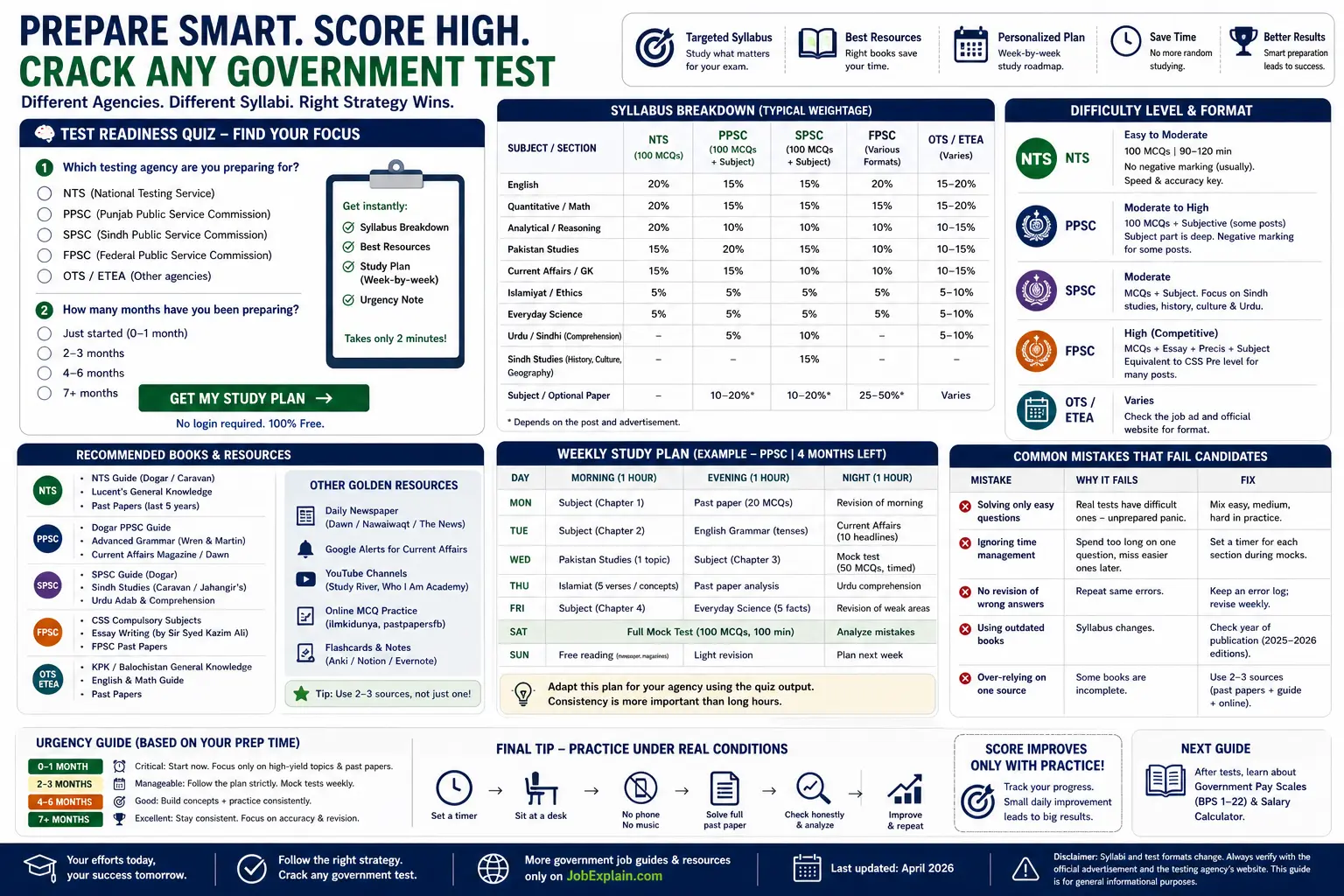
Most applicants prepare the same way for every test: buy a guide book, solve some past papers and hope. But FPSC, PPSC, SPSC and NTS do not run the same kind of test. Paper length, passing marks and negative marking all differ, and the difference changes how you should prepare and how you should answer on the day.
Everything below comes from the commissions’ own documents: FPSC’s general instructions (updated 12 August 2026) and PPSC’s Important Instructions to Candidates (8 October 2026). Pick your test in the finder below and it shows only the rules that apply to it.
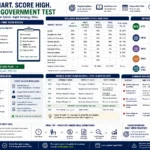
Government Job Test Format Finder (NTS, PPSC, SPSC, FPSC)
Choose the commission, and for FPSC the grade of the post. The tool shows only what the commission has published; where it has not published a fixed format, it tells you where to find it for your test.
FPSC Test Pattern: What the Commission Says
FPSC’s instructions say it conducts tests for all the posts it recruits for in BS-16 and above, and that the test for every post is MCQ based. The paper depends on the grade:
| Grade | Paper | Time | Pass mark |
|---|---|---|---|
| BS-16 and 17 | One MCQ paper, 100 marks | 100 minutes | 40% |
| BS-18 and 19 | One MCQ paper, 200 marks, two parts | 200 minutes | 40% in each part |
| BS-20 and 21 | One MCQ paper, 200 marks, two parts | 200 minutes | 50% in each part |
For BS-18 and 19, Part II (50%) is the professional or subject part, and Part I depends on the kind of post: English plus general intelligence for engineers and similar professional posts, English plus teaching methodology for teaching posts, English plus public administration and related subjects for general management posts, and core MBBS subjects for doctors. The syllabus for each post is uploaded on the FPSC website before the test, so that document, not a guide book, is your real list of topics.
Two other points from the instructions are worth knowing before you sit the paper. Results are first published as a merit order of pass and fail candidates without marks, and FPSC does not entertain requests for rechecking. Only candidates who pass the test are shortlisted for document checks and interview, usually three to five per post depending on the grade and quota. Before you prepare, check that your post goes through FPSC at all: many lower-grade FBR jobs, for example, are advertised by the department itself.
PPSC Test Pattern: What the Commission Says
- Kind of paper: a written test can be descriptive (subjective), MCQ, or a mix of both. The syllabus for each post is on the PPSC website.
- Negative marking: 0.25 marks are deducted for each wrong answer in MCQ papers.
- Pass mark: 40% in an MCQ written test. In a written examination with several papers, 40% in each paper and 50% in aggregate.
- Interview: five candidates per post are normally called, taken from the top of the test merit, and you need at least 50% in the interview.
- Chances: PPSC’s Important Instructions (October 2026) allow five chances for a post filled through a written test and interview, or interview alone, and three for competitive examinations. A chance is counted when you fail; there is no limit while you reach 40% in the written test and 50% in the interview.
SPSC and NTS: Check the Notice for Your Test
SPSC takes applications online through spsc.gov.pk and holds a written examination or test for its posts. Its advertisements do not fix a single pattern for every post, so read the test schedule and syllabus notice for your case on the SPSC website. Our SPSC jobs guide covers the posts open now, the 33% written-test pass mark and how many candidates are called to interview. If you have a permanent disability and need assistance in the test, SPSC asks you to apply at least seven days before the test with your disability certificate and special CNIC.
NTS conducts tests for many different departments and organisations, and each one is designed for that client. The number of questions, the time, the sections and whether wrong answers are penalised are all given in the guidelines for that specific test on nts.org.pk. As one example of how much this varies, NTS’s guidelines for a Pakistan Science Foundation test stated that there would be no negative marking. Do not assume the rules of one NTS test apply to the next. Forces that recruit on their own work the same way: Pakistan Rangers Sindh, for example, measures height and chest and holds a running test before its written paper, and its ads publish no syllabus.
How Negative Marking Should Change the Way You Answer
Both FPSC and PPSC deduct 0.25 marks for a wrong MCQ answer. Here is what that means in numbers, assuming each question has four options (check your paper):
- Pure guess among four options: a 1 in 4 chance of +1 and a 3 in 4 chance of −0.25. On average that is +0.06 marks per question, so blind guessing gains almost nothing and adds risk.
- You can rule out one option: the average rises to about +0.17 marks per question.
- You can rule out two options: it rises to about +0.38, and the guess is clearly worth taking.
The practical rule: leave a question blank when you have no idea, and answer when you can confidently cut the options down to two. Practise this on past papers so that it is a habit before the real test, and remember that in an NTS test without negative marking the advice is the opposite: answer everything.
Common Mistakes That Fail Candidates
| Mistake | Why it fails | Fix |
|---|---|---|
| Preparing from a guide book instead of the official syllabus | The commission sets the paper from the syllabus it publishes for the post | Download the syllabus for your post from the commission’s website first |
| Guessing every question | With 0.25 negative marking, wild guesses eat into your score | Answer only when you can cut the options down |
| Ignoring time management | Too long on one question, easier ones left unread | Practise full papers under the real time limit |
| No revision of wrong answers | The same errors repeat | Keep an error log and revise it weekly |
| Relying on one source | Some books are incomplete or out of date | Use the syllabus, past papers and a current affairs source together |
Sample Weekly Study Plan for a One-Paper MCQ Test
This is a starting template, not an official plan. Replace the subjects with the headings in the syllabus for your post.
| Day | Morning (1 hour) | Evening (1 hour) | Night (1 hour) |
|---|---|---|---|
| Mon | Subject (Chapter 1) | Past paper (20 MCQs) | Revision of morning |
| Tue | Subject (Chapter 2) | English Grammar (tenses) | Current Affairs (10 headlines) |
| Wed | Pakistan Studies (1 topic) | Subject (Chapter 3) | Mock test (50 MCQs, timed) |
| Thu | Islamiat (5 verses / concepts) | Past paper analysis | Urdu comprehension |
| Fri | Subject (Chapter 4) | Everyday Science (5 facts) | Revision of weak areas |
| Sat | Full mock test under the real time limit | Analyse mistakes | Rest |
| Sun | Free reading (newspaper, magazines) | Light revision | Plan next week |
Final Tip: Practise Under Real Conditions
Set a timer for the real duration of your paper. Sit at a desk with no phone. Solve a full past paper in one sitting, mark it with negative marking applied, and check your answers honestly. Repeat the exercise a week later and compare. Improvement between attempts is the number that matters.
Before the test stage, make sure you are eligible and that the post is worth it. Check your exact age on the closing date, compare grades in our BPS pay scale chart for 2026, and get your degrees ready with our document attestation guide, because FPSC and PPSC check your documents at the interview stage.
Not every employer tests through a commission or NTS. NADRA runs its own online test, and its sample papers are covered in our NADRA jobs guide. Khyber Pakhtunkhwa’s teaching hospitals send many posts to ETEA, as our MTI Abbottabad guide explains. BISP has published a subject-wise syllabus for its Compliance Monitor test, which you can see in our BISP jobs guide.
Documents We Checked
- FPSC General Instructions, updated 12 August 2026 (test type, marks, time, pass marks, negative marking, shortlisting, interview)
- PPSC website: Important Instructions to Candidates (8 October 2026) (kinds of paper, negative marking, qualifying marks, interview, chances)
- SPSC website: Consolidated Advertisement No. 05/2026 (online applications, assistance for candidates with disabilities)
- NTS website: guidelines for candidates published for each test
We went through these instructions again in October 2026. If your test notice says something different from this page, follow the notice.









7 thoughts on “Government Job Test Patterns 2026: FPSC, PPSC, SPSC and NTS Rules and a Study Plan”