Written by Shani Imanatullah, JobExplain.com
When I applied for my first government job, I made a mistake that almost every fresh graduate makes: I got my documents attested from the wrong authority. I had a bachelor’s degree from a Pakistani university, so I went to my university’s registrar office and got a stamp that said “Verified”. I thought that was enough.
It wasn’t.
The PPSC rejected my application because my degree was not attested by HEC (Higher Education Commission). I had to run from HEC office to my university and back, wasting two weeks and extra money. I learned that attestation is not just a stamp – it’s a chain of verification. And each type of document needs a specific attesting authority.
In this guide, I will walk you through exactly which authority attests which document, how to get it done quickly (even if you live far from the major cities), and the small details that cause 90% of attestation-related rejections.
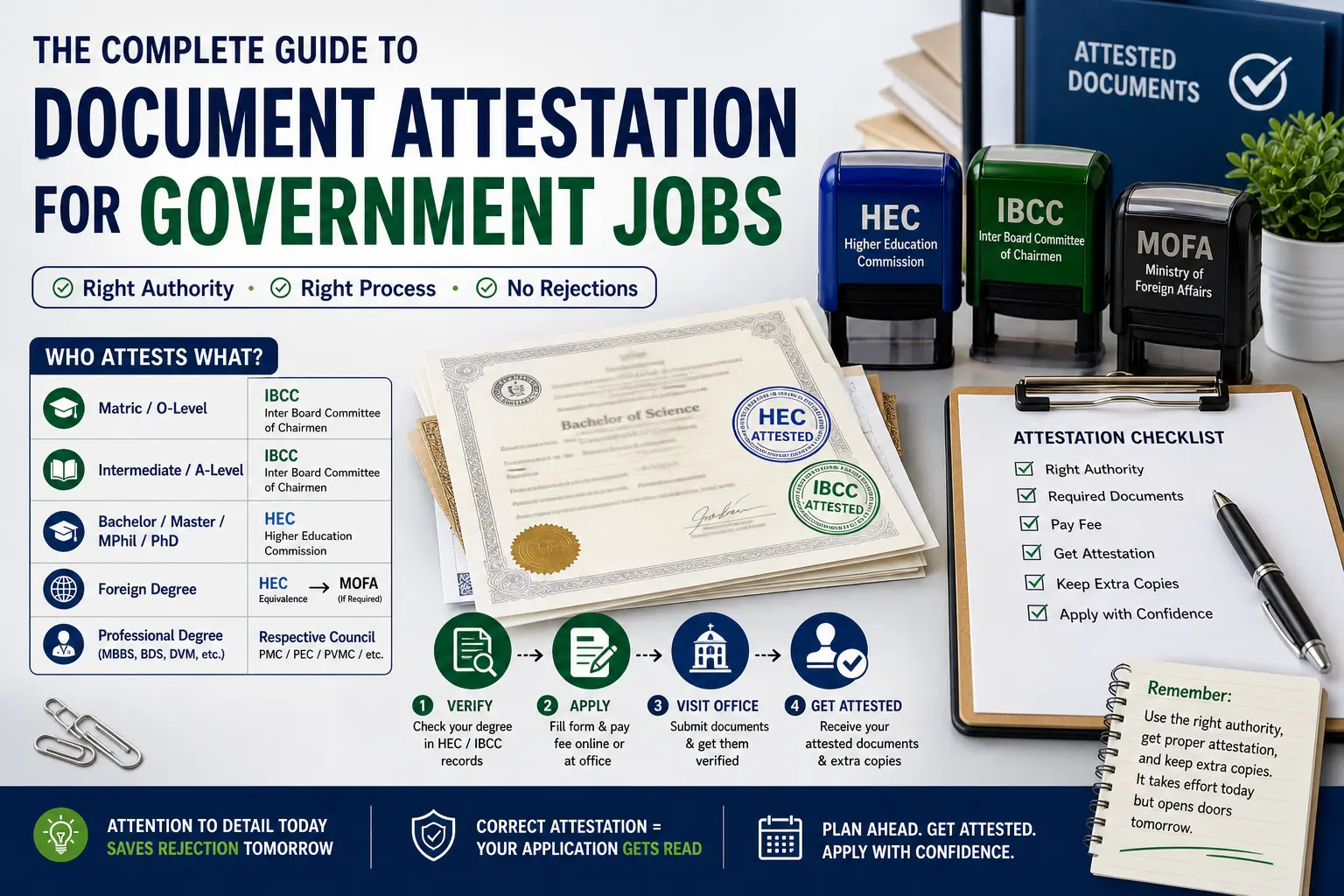
Quick Reference: Who Attests What?
Here is the simple answer – but read the full guide because there are important exceptions.
| Type of Document | Attesting Authority | Typical Fee (per copy) | Processing Time |
|---|---|---|---|
| Matric certificate (or O‑Level) | IBCC (Inter Board Committee of Chairmen) | ~PKR 1,000 – 2,000 | 1‑14 days (walk‑in same day) |
| Intermediate certificate (or A‑Level) | IBCC | ~PKR 1,000 – 2,000 | 1‑14 days |
| Bachelor’s, Master’s, MPhil, PhD (Pakistani university) | HEC (Higher Education Commission) | ~PKR 1,500 – 3,000 | 3‑21 days (walk‑in same/next day sometimes) |
| Foreign degree | First HEC for equivalence, then MOFA (if required for overseas jobs) | Varies | Several weeks |
| Professional degree (MBBS, BDS, DVM) | Respective council: PMC, PEC, PVMC, etc. | Varies | Varies |
Important: Some government departments (like NADRA, WAPDA, or certain ministries) may accept university attestation for intermediate or lower documents, but for competitive exams (PPSC, SPSC, FPSC) and most gazetted positions, you must have IBCC (for Matric/Inter) and HEC (for degrees).
🧭 Which Attestation Authority Do You Need?
Answer 2–3 quick questions. Get an instant answer (no download required).
Why You Cannot Rely on University Attestation Alone
Many universities have their own “attestation cell”. They will stamp your degree and even put a sticker. But for government jobs in Pakistan, that stamp is like a piece of paper without a signature. The recruiters want the official HEC stamp because HEC maintains a centralised database of all degree holders.
I once talked to an HR officer at the Punjab Public Service Commission. He told me, “We reject about 15% of applications because candidates send university‑attested copies instead of HEC‑attested ones.” That’s thousands of people every year who spend money on application fees and courier but get rejected before their file is even opened.
So my first advice: If the job ad says “attested copies”, and it’s a government job, assume they mean IBCC for school certificates and HEC for university degrees. Don’t take shortcuts.
Step‑by‑Step: IBCC Attestation (For Matric & Intermediate)
IBCC stands for Inter Board Committee of Chairmen. They have regional offices in Islamabad, Lahore, Karachi, Peshawar, Quetta, and Multan. If you live far, you can apply by post – but I recommend walk‑in if possible because postal can take weeks.
Method 1: Walk‑in (Same Day or Next Day)
- Prepare your original certificates – the original Matric certificate (or O‑Level certificate with equivalence certificate) and original Intermediate certificate. You will need to show them.
- Make photocopies – take at least 2 copies of each certificate. Also take a copy of your CNIC.
- Fill the application form – you can download it from the IBCC website (
ibcc.edu.pk) or get it at the office. - Go to the IBCC regional office – I recommend going early morning (around 9 AM) to avoid long queues. The Lahore office on Temple Road is usually busy; try Tuesday or Wednesday.
- Submit forms and pay fee – they will tell you the exact fee. Keep the receipt.
- Get your certificates stamped – for walk‑in, they usually give back the attested copies within a few hours or the next working day.
Pro tip: Bring a black pen and a file to keep your documents safe. Also bring cash – many offices do not accept cards.
Method 2: Postal Application (If You Live Far)
- Download the form from the IBCC website.
- Attach attested photocopies of your certificates (attested by a gazetted officer? Wait: Actually, for postal, you send your original certificates? No, I never send originals by post. Let me be clear: IBCC postal application requires you to send photocopies first, and they verify online. But to be safe, call the helpline. I personally never used postal because of risk of loss. My advice: travel to the nearest IBCC office even if it’s a day trip.
What I do: I ask a friend or relative in Lahore or Islamabad to go on my behalf. You can give a signed authorization letter and a copy of your CNIC. That works.
Step‑by‑Step: HEC Attestation (For Bachelor’s, Master’s, MPhil, PhD)
HEC attestation is more complex because they have an online verification system. You must follow these steps carefully.
Step 1: Verify Your Degree Online
Before you go to the HEC office, check that your degree is already in the HEC database. Go to hec.gov.pk → “Verification” → “Degree Attestation”. Enter your degree details. If your degree is not found, your university may not have uploaded it. In that case, contact your university’s registrar first.
I have seen cases where students graduated 5 years ago but their degree never made it to HEC’s system. You will not get attestation until your university uploads the data.
Step 2: Create an Account on HEC’s Attestation Portal
HEC now requires online application before walk‑in. Go to eportal.hec.gov.pk and register. Fill the form with your degree details, choice of HEC regional office (Islamabad, Lahore, Karachi, Peshawar, Quetta), and pay the fee online (or get a challan).
Fee for HEC attestation (as of 2025‑2026):
- For single degree: ~PKR 1,500 – 2,500
- For multiple copies of same degree: extra per copy
Keep the payment receipt (either email or printed challan).
Step 3: Prepare Your Documents
You will need:
- Original degree certificate (the one with the university seal)
- Original transcript (detailed mark sheet)
- Copy of CNIC
- HEC online application printout
- Challan receipt
Important: HEC will not attest a degree without the original transcript. Many students forget the transcript and are turned away.
Step 4: Visit HEC Regional Office
Take all originals plus at least 2 sets of photocopies. At the counter, they will verify your documents against the online database. Then they will stamp the original degree and transcript – but they also may keep a copy.
Processing time: If you go in the morning and there is no rush, you can get it same day. Otherwise 3‑5 working days.
Pro tip: The HEC office in Lahore (on Ferozepur Road near Thokar Niaz Baig) is less crowded than the Islamabad office. If you are in Punjab, go to Lahore.
Step 5: Collect Your Attested Documents
They will give you a token or tracking number. I have seen cases where they lose documents, so always keep a photocopy of the submission receipt and note the name of the person who accepted your documents.
Special Case: Attestation of O‑Level / A‑Level Certificates
If you have done O‑Level or A‑Level (Cambridge), you cannot get them attested directly. You must first get an equivalence certificate from IBCC.
Process:
- Take your original O‑Level certificate and statement of marks to the IBCC office.
- Apply for equivalence (they will convert your grades into Pakistani percentages).
- Once you have the equivalence certificate, get that attested by IBCC – not the original Cambridge certificate.
For government jobs, you will submit the attested IBCC equivalence certificate, not the Cambridge documents. This is a very common point of confusion.
When You Need MOFA Attestation (And When You Don’t)
MOFA stands for Ministry of Foreign Affairs. MOFA attestation is only required if:
- You are applying for a job in another country (e.g., UAE, Saudi Arabia, etc.) that asks for attested degrees.
- You are applying for a Pakistan government job that specifically requires “MOFA attested” – which is rare for local candidates.
Do not waste money on MOFA attestation unless the advertisement explicitly says “MOFA attested”. For 99% of government jobs in Pakistan (PPSC, SPSC, FPSC, NTS, NADRA, etc.), HEC attestation is enough.
If you do need MOFA, the process is: HEC attestation → then MOFA attestation. MOFA has its own counter in HEC office (Islamabad) or you go to MOFA office in Islamabad. MOFA will stamp after HEC.
Common Attestation Mistakes That Get Your Application Rejected
I have seen these mistakes repeatedly. Learn from others’ errors:
- Using university attestation for HEC‑required documents. As mentioned, this is the #1 mistake. Always check the job ad’s wording: “attested copies” – if it doesn’t specify, call the department. But when in doubt, use HEC.
- Attesting only the degree, not the transcript. Many candidates bring only the degree certificate. The recruiting agency may also need the transcript (detailed marks) attested. Some ads say “degree and transcript” – read carefully.
- Submitting colour photocopies instead of original attestation. You cannot submit a scanned copy of an attested document. You must submit the physically stamped copy. I made this error once: I scanned my HEC‑attested degree and printed a colour copy. The recruiter rejected it because the stamp was not original. Always send the original attested document (or a photocopy of the attested document? Actually, you send photocopies of the attested originals – but those photocopies must be taken after attestation. The originals you keep. It’s messy. I’ll clarify: For your application, you submit photocopies of your attested certificates. The original attested certificates stay with you. However, those photocopies must be clearly stamped. Some departments require you to get the photocopies also attested by a gazetted officer? I recall that for certain posts, they ask for “attested photocopies” – meaning you take a photocopy and then get that photocopy attested by a Class‑I officer. Check the ad.)
- Not keeping extra copies. Once you get a document attested by HEC or IBCC, ask them to attest at least 3‑4 extra photocopies at the same time. It costs a little extra but saves you from going back later. Trust me, you will need multiple copies for different applications.
- Applying for IBCC attestation with a CNIC that has a different name spelling. Your matric certificate may have a slightly different name (e.g., “Shani Imanatullah” vs “Shani Imamatullah”). IBCC may reject if names don’t match. You will need an affidavit explaining the difference. Solve this before you go.
Real‑Life Story: How I Wasted Two Days Because of One Missing Stamp
When I was applying for a job in the Ministry of Defence, I sent my HEC‑attested degree copy. The application came back with a note: “Transcript not attested.” I had completely forgotten to get my transcript attested. So I had to travel back to HEC Lahore, stand in line, and pay again. The deadline was near, and I nearly missed it.
Now I have a checklist that I follow for every application. I am sharing it with you below.
Attestation Checklist (Print This Before You Apply)
- For Matric/Intermediate: IBCC attestation obtained (not just university stamp).
- For O‑Level/A‑Level: Equivalence certificate from IBCC, then attestation of that certificate.
- For Bachelor’s or higher: HEC online application completed and fee paid.
- Original degree certificate + original transcript ready.
- At least 2 attested photocopies of each document (get extra while at the office).
- If the job ad says “attested by a gazetted officer”, get a photocopy of your HEC/IBCC attested document, then ask a Grade‑17 or above government officer (school principal, assistant commissioner) to stamp and sign the photocopy. This is separate from HEC/IBCC.
- Keep all original attested documents in a safe folder. Do not send originals in application.
FAQ – Attestation for Government Jobs
Q: Can I get my degree attested from my university instead of HEC?
A: For government competitive exams (PPSC, SPSC, FPSC), NO. For some direct department jobs (e.g., WAPDA), they may accept university attestation. But to be safe, use HEC.
Q: My university closed down. How can I get HEC attestation?
A: HEC still has records of closed universities. You will need to provide a copy of your degree and transcript, and HEC may ask for an affidavit. Contact HEC’s verification department directly.
Q: How long does HEC attestation take by post?
A: I do not recommend postal because it can take 4‑6 weeks. If you live far, use a courier service like TCS to send your documents to a trusted person in the city who can walk in on your behalf.
Q: Do I need to attest my CNIC?
A: No. Only educational documents are attested. CNIC is submitted as a copy without attestation, but sometimes you need a “verified copy” of CNIC from NADRA – that’s a different process called “NADRA verification”.
Q: What is the fee for IBCC attestation of O‑Level equivalence?
A: As of April 2026, it is around PKR 2,000 – 3,000 for equivalence plus attestation. Check the IBCC website for latest fee.
Q: Can I get digital/online attestation?
A: HEC has a “Digital Degree” verification system. Some departments accept printouts of digital degrees with QR codes. But most still want physical stamps. For safety, get the physical stamp.
Final Pro Tips
- Keep a digital scan of your HEC‑attested degree and transcript. You can use it for online applications, but for physical submissions always send stamped copies.
- If you reappear for a job application, do not send the same photocopies repeatedly – they may get torn or faded. Make fresh photocopies from your master attested copy.
- Never give your original attested documents to any employer. Only submit photocopies. Employers sometimes “lose” originals.
Conclusion
Attestation is a boring, time‑consuming step. But it is the difference between your application being opened or thrown into the rejection pile. Do not skip it, do not take shortcuts, and do not assume that a university stamp is enough.
I have given you the exact steps for IBCC, HEC, and the special case of O‑Levels. I have shared my own mistakes so you don’t repeat them.
Now go get your documents attested – and then apply with confidence.
🔗 Explore more government job guides on JobExplain.com
Last updated: April 2026
Disclaimer: Fees and processing times change. Always check the official IBCC (ibcc.edu.pk) and HEC (hec.gov.pk) websites for the latest information. I am not affiliated with IBCC or HEC. This guide is based on personal experience and research.